

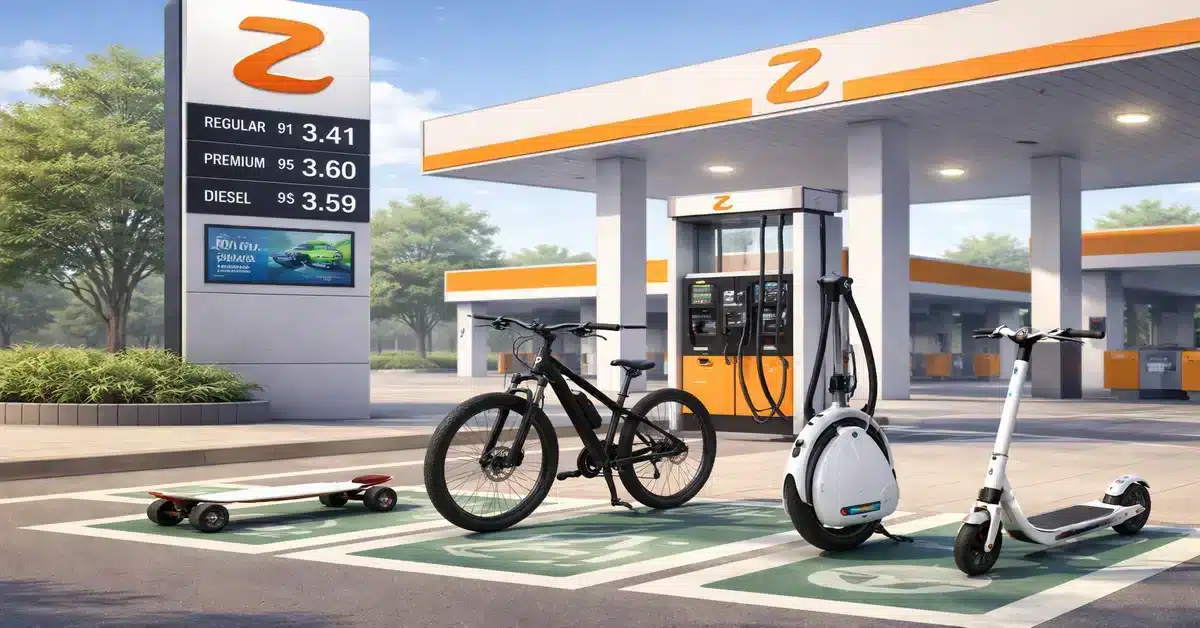
With fossil fuel costs soaring in 2026, unstable supply lines, and environmental concerns around extracting and burning fossil fuels, many people are looking for ways to reduce their weekly costs.
There are many reasons people choose to ride a personal electric vehicle (PEV): the sheer joy of having more freedom riding, a chance to de-stress and escape traffic, adrenaline sports, riding socially with friends, exploring paths less traveled, and of course as a practical commuting device. In this article we delve into the economics of owning a PEV, whether it makes sense financially to purchase a PEV to replace some trips that might otherwise be taken using a car.
Car Running Costs in New Zealand
Petrol cars generally consume 7-8 litres per 100 km, larger SUVs consume 8-9 litres, and smaller diesel cars 6-7 litres. With petrol prices in NZ currently around NZ$3.40 per litre (and rising) and diesel increasing to $3.55 per litre, this gives a fuel cost for a petrol cars around $0.26/km, SUV around $0.29/km, and diesel cars around $0.23/km.
Electric car energy efficiency vary a little depending on model, driving style and road conditions. At a typical home electricity rate of $0.25/kWh a more efficient EV model might cost around $0.045/km in electricity costs, or a sportier or larger model around $0.06/km. These costs more than triple when using a public charger (costing around $0.80/kWh). Solar recharging is an option, but an electric vehicle battery of 60 kWh would take days to fully recharge purely by a typical 4.4 kWh (at peak) home solar system. To these costs in NZ road user charges now apply to electric cars, adding $0.076/km to the costs to give around $0.125/km. Diesel cars also pay the same road user charge.
However, these costs ignore the vehicle regular maintenance (estimated by evdb.com around $0.05/km for combustion engines and $0.03/km for electrics) and repairs (averaging around $1600/year), tyre replacements (around $0.03/km), insurance (averaging around $1600/year), warrant of fitness ($89/year) and registration ($170-$240/year), depreciation (typically around $3600-$4200/year), parking and tolls (varies a lot but averaging around $500/year across NZ). These costs approximately add an extra $0.06-$0.08/km in running costs and around $7900/year in ownership costs per vehicle. On average in NZ cars are each driven for around 12000 km/year so the ownership costs add $0.66/km.
Personal Electric Vehicle Running Costs in New Zealand
There are many types of personal electric vehicles (PEV) available in New Zealand, including electric bikes, electric scooters, electric skateboards, onewheels, and electric unicycles. Their capabilities, range, and power vary significantly but in general they cost around $0.0035-$0.004/km in electricity (using $0.25/kWh electricity costs so ignoring solar and free charging options). This cost depends a lot on rider weight, how fast they are ridden, terrain, and the frequency of accelerating/braking.
Some of the smallest PEV models can be even more efficient but are less used for regular commuting. Electric bikes can achieve better efficiency (down to $0.002/km) when ridden on flat paved surfaces with minimal braking and more pedal effort. The PEVs with regenerative braking (electric skateboards, onewheels, electric unicycles) can improve their efficiency by around 10% on more hilly terrain or with frequent changes in speed compared to non-regenerative PEVs (most electric bikes and electric scooters). The most significant regular costs for PEVs are tyre changes around $0.02-$0.05/km (depending on the PEV and whether the tyre change is undertaken professionally), and optional servicing (especially for electric bikes and scooters with more moving mechanical parts) at around $0.02-$0.10/km.
How Soon Does a PEV Pay for Itself
Electric vehicles have around half the running costs of petrol and diesel cars, and PEVs are a factor of more than ten times less again.
Based only on running costs and current prices here is how far some common PEVs would need to be ridden instead of using an existing petrol or electric car on trips in order to pay for their purchase prices due purely to savings in running costs versus a car.
| PEV Model | Regular Price | Distance to Pay Off Versus Petrol Car | Distance To Pay Off Versus Electric Car |
|---|---|---|---|
| Evolve GTR Bamboo | $2099 | 6600 km | 13000 km |
| Evolve Diablo Carbon | $3499 | 11000 km | 21700 km |
| Meepo V5 ER | $1199 | 3800 km | 7400 km |
| Meepo Voyager X | $1999 | 6300 km | 12400 km |
| Inmotion V8S | $1799 | 5700 km | 11100 km |
| Inmotion V12S | $4199 | 13300 km | 26000 km |
| Inmotion P6 | $8599 | 27200 km | 53300 km |
| KingSong 14D | $1399 | 4400 km | 8600 km |
| KingSong S16/S16Pro | $3399 | 10700 km | 21000 km |
| KingSong F18 | $5699 | 18000 km | 35300 km |
| Funwheel X7 Sport | $4699 | 14800 km | 29100 km |
| Funwheel X7 Long Range | $5499 | 17400 km | 34100 km |
| Funwheel X7 Supercharged | $6299 | 19900 km | 39000 km |
If the PEV actually replaces a car ownership then the PEV pays for itself much sooner. For example, if the most expensive P6 listed in the table replaces a small petrol or electric vehicle in a household it pays for itself after around 8000-10000 km usage.
What Other Economic Factors
Reducing reliance on fossil fuels has other economic benefits, particularly for the environment. The Colorado State University produced the following infographic showing CO2 output for different forms of transport in the US.
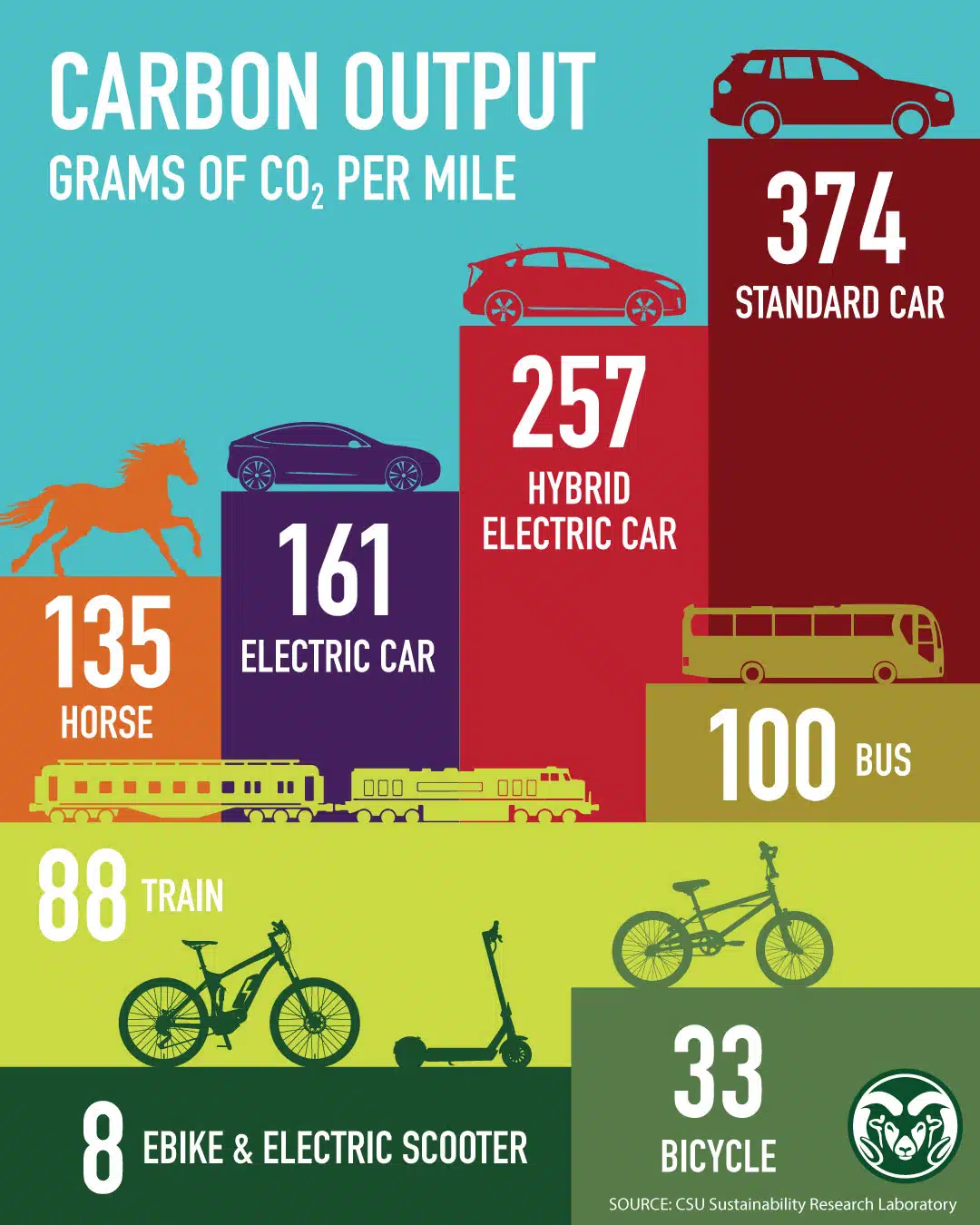
In NZ our electricity generation is mostly renewable so produces around 113g per kWh rather than the US 369g per kWh used in the Infographic. So in NZ these numbers translate to PEVs 1.5 g/km, bicycles 20.5 g/km, trains 55 g/km or 16.7 g/km for electrified trains, buses 62 g/km or 19 g/km if electrified, electric cars 30.6 g/km, petrol cars 232 g/km.
Compared to PEVs surprisingly bicycles are not as efficient for the environment as many people might think (humans are not very efficient motors). An electric bus needs to have more than 12 passengers to be comparable to those passengers each riding PEVs, and a non-electric bus over 40 passengers. Only electrified trains carrying many passengers to the same destinations can realistically achieve a lower carbon footprint than having individuals riding PEVs.
In NZ carbon emission costs are costed using the NZU (New Zealand Unit). Each NZU represents one metric tonne of carbon dioxide equivalent (CO2e). Its price has been quite volatile but is roughly around $50 per NZU. Using the NZU for carbon cost a PEV would achieve 13000 km per dollar NZU, an electric car 652 km per dollar, and a petrol car 86 km per dollar.
For those that prefer water transport, a typical jetski (averaged across ten popular models) at cruising speed (not full throttle) produces around 282 g CO2 per km, so a bit worse than a car, whereas an eFoil is around 2.6 g CO2 per km.
For recycling costs at end of life, a PEV typically weighs between 15-50 kg and has a 0.5-4 kWh battery requiring disposal, an electric car 1500-3000 kg with a 50-100 kWh battery, and a petrol car a little less at 1200-2500 kg.
Summary
Based solely on cost, it makes sense to leave the car in the driveway for some trips and instead take a low-mid level PEV when the total travel of the PEV during its lifetime would be over 10000 km (or 20000 km if its an electric car left in the driveway for a single person trip). For high end PEVs the lifetime distance traveled needs to double, but if the PEV is replacing a car (petrol or electric) then the reduction in car ownership costs makes purchasing even a high end PEV quickly worthwhile. Including tolls or factoring in non maintenance repairs skews the economics further toward PEVs.
For environmental impact costs the smartest choice is either to ride a PEV or be a passenger on a busy train, rather than choosing a bicycle or bus.