
The popularity of personal electric vehicles (PEV, or personal mobility devices) has grown enormously over the past decade, with rapid advances in electric motor design and battery technologies making a diverse range of PEV practical for many everyday situations.
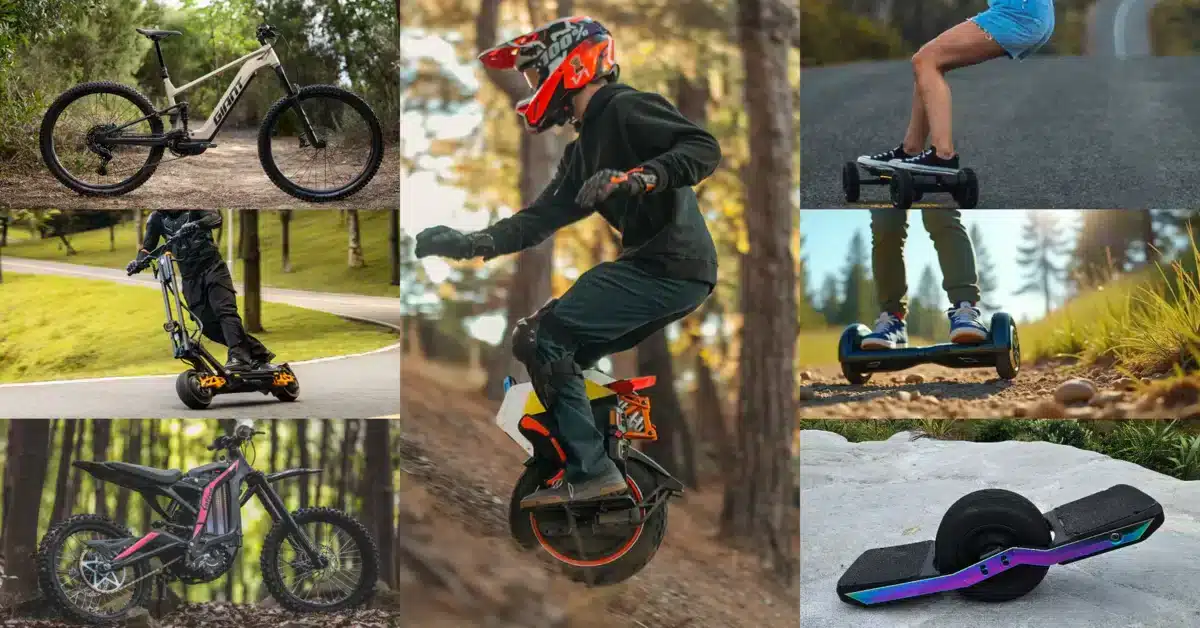
The most popular types of PEV are electric bikes, electric scooters, hoverboards and electric motorbikes, followed by electric skateboards, onewheels, and electric unicycles. Although they all share the same concepts of (1-4) electric motors and lithium-ion batteries, they differ enormously in their capabilities, use cases and ride experience.
The best type of PEV for a person is very subjective and depends on many factors which are discussed here.
Specifications
Besides the specifications varying greatly between types of PEV they also vary a lot between different models of the same type. To make the comparison fairer two models for each PEV type are chosen, one popular entry-level model and one high-end model that is available in 2026 throughout NZ:
- electric bike: Giant Talon E+ and the Whyte E-Lyte 150.
- electric scooter: Kaabo Urban and the Inmotion RS.
- hoverboard: Swagboard T580 and the Gyroor G2.
- electric motorbike: Surron Light Bee and the Stark Varg.
- electric skateboard: Meepo V5 ER and the Evolve Renegade Diablo.
- onewheel: Future Motion Pint X and the Fungineers X7 Supercharged.
- electric unicycle: KingSong 14D and the Inmotion P6.
Manufacturers provide range and top speed figures, but these are always optimistic and measured under ideal situations. More useful for range comparisons is to consider the battery capacities, measured in Watt-hours (although the model of the battery cells also plays a significant role). The motor wattage gives the power of the motor (measured as nominal/sustainable and maximum instantaneous peak) and an indication of its available torque for handling hills and obstacles. The motor voltage influences how efficiently the motor performs under load, with higher voltage motors better able to sustain performance on hills or with heavy riders. Larger batteries and more powerful motors give a better ride but add to the PEV weight and overall cost.
| PEV | Range | Top Speed | Weight | Motor (peak) | Battery | Voltage | Regular Price (NZD) |
|---|---|---|---|---|---|---|---|
| E-bike – entry level | 115 km | 25-45 km/h | 21.7 kg | 250 (500) Watt | 430 Wh | 36 Volt | $ 5299 |
| E-bike – high end | 160 km | 25-45 km/h | 18.9 kg | 250 (600) Watt | 650 Wh | 36 Volt | $19999 |
| E-scooter – entry level | 40 km | 40 km/h | 20 kg | 500 (1092) Watt | 499 Wh | 54.6 Volt | $ 1799 |
| E-scooter – high end | 160 km | 110 km/h | 58 kg | 4000 (8400) Watt | 2880 Wh | 72 Volt | $ 7250 |
| Hoverboard – entry level | 11 km | 12 km/h | 6.4 kg | 400 (400) Watt | 67.3 Wh | 24 Volt | $ 332 |
| Hoverboard – high end | 15 km | 12 km/h | 14 kg | 700 (700) Watt | 144 Wh | 36 Volt | $ 499 |
| E-moto – entry level | 75 km | 75 km/h | 45 kg | 3000 (6000) Watt | 2400 Wh | 60 Volt | $ 8199 |
| E-moto – high end | 80 km | 120 km/h | 118 kg | 20000 (60000) Watt | 7200 Wh | 360 Volt | $20900 |
| E-skateboard – entry level | 32 km | 45 km/h | 8.6 kg | 1000 Watt | 288 Wh | 36 Volt | $ 1199 |
| E-skateboard – high end | 50 km | 50 km/h | 16.4 kg | 7000 Watt | 864 Wh | 43.2 Volt | $ 3699 |
| Onewheel – entry level | 24 km | 29 km/h | 12.2 kg | 750 Watt | 324 Wh | 63 Volt | $ 2699 |
| Onewheel – high end | 37 km | 65 km/h | 17.2 kg | 6500 Watt | 576 Wh | 134 Volt | $ 6299 |
| EUC – entry level | 40 km | 30 km/h | 14.5 kg | 800 (2400) Watt | 420 Wh | 67.2 Volt | $ 1399 |
| EUC – high end | 150 km | 150 km/h | 51 kg | 6000 (20000) Watt | 4200 Wh | 235 Volt | $ 8599 |
Just from the specs table some PEV options can be narrowed down, for instance hoverboards are only suitable for very brief commutes, whereas e-moto weights make them impractical to regularly lift in and out of vehicles, so cannot integrate well with public transportation.
Riding Experience
The riding experience is very subjective, and generally most PEV riders are very happy with their ride choice without trying alternatives. The following table summaries the ride experience according to some categories:
- how easy it is to learn to ride a PEV the first time,
- general rider satisfaction/fun staying with the same type of PEV long term,
- how easy it is to carry/move/lift the PEV while not riding,
- the acceptance by the non-riding public and adherence to regulations,
- options for upgrades after the initial purchase,
- customisation options such as consoles or ride apps that allow the ride experience to be configured.
| PEV | Learning Curve | Rider Satisfaction | Portability | Public Acceptance | After-market Upgrades | Ride Customisation |
|---|---|---|---|---|---|---|
| E-bike | ★★★★ | ★★ | ★ | ★★★★ | ★★★ | ★ |
| E-scooter | ★★★★ | ★★ | ★★ | ★★★ | ★★ | ★★ |
| Hoverboard | ★★★ | ★ | ★★★★ | ★★★ | ★ | ★ |
| E-moto | ★★ | ★★★ | ★ | ★ | ★★★★ | ★★ |
| E-skateboard | ★★ | ★★★ | ★★★★ | ★★★ | ★★ | ★★ |
| Onewheel | ★★ | ★★★★ | ★★★ | ★★★ | ★★★★ | ★★★★ |
| EUC | ★ | ★★★★ | ★★★★ | ★★ | ★★ | ★★★ |
E-bikes and e-motos having a significantly lower learning curve for most people as many already know how to ride bicycles. E-motos in particular are subject to a lot of criticism when used in public spaces, often due to a perception of young e-moto riders being reckless and performing wheelies on roads. Although transport regulations nowadays accommodate e-scooters, they limit the approvals to only the lowest power models. EUCs and particularly VESC-based onewheels allow a lot of configuration through ride apps, with a range of ride modes/tunes to suit different use cases.
Safety is another important consideration, for novice riders, experienced riders and for other people. Surprisingly e-bikes have a high injury rate (about triple that of bicycles for distance traveled), which can be attributed to both a lack of adequate protective gear and high speed amongst inexperienced riders. Many of those incidents involve other vehicles. Similarly there are many e-scooter accidents due to novice and intoxicated riders failing to even wear helmets. E-moto incidents receive disproportionate publicity compared to their injury rate but their speeds can result in more serious injuries. Novice EUC riders often have minor falls, far less common amongst experienced riders but the EUC community has been very good at promoting the wearing of protective gear. This makes it difficult to get comprehensive statistics to objectively compare the safety across different PEV, with safety more determined by the rider behaviour and wearing of adequate protective gear than by the PEV itself.
Servicing and Maintenance
The serviceability and maintenance requirements become important considerations as PEVs typically get used for multiple years. The following table summarises the most important considerations:
- how reliable and robust the PEV is (often dependent on the individual brand),
- how resistant the PEV is generally to water ingress, particularly the battery pack, often stated though a tested IP rating,
- the regular maintenance effort (excluding tyre changes),
- how challenging a typical tyre change is to perform,
- how easy it is to undertake servicing and repairs,
- the common lifetime of the PEV.
| PEV | Reliability/Robustness | Water Resistance | Maintenance Ease | Tyre Change | Servicing Ease | Lifetime |
|---|---|---|---|---|---|---|
| E-bike | ★★★ | ★★★★ | ★★ | ★★★ | ★★★★ | ★★★★ |
| E-scooter | ★★ | ★★ | ★★ | ★★★ | ★★★ | ★★ |
| Hoverboard | ★ | ★ | ★★★★ | ★★ | ★★ | ★ |
| E-moto | ★★★★ | ★★★★ | ★ | ★★ | ★★ | ★★ |
| E-skateboard | ★★ | ★★ | ★★★ | ★★★★ | ★★★★ | ★★★ |
| Onewheel | ★★★★ | ★★★ | ★★★★ | ★★ | ★★★ | ★★★★ |
| EUC | ★★★★ | ★★★ | ★★★★ | ★ | ★ | ★★★★ |
PEV intended for for off-road use, such as e-motos, onewheels and many EUCs are usually designed with higher robustness, and superior waterproofing. E-motos generally require more regular maintenance, partially due to their frequent and demanding off-road use. Although regular maintenance requirements for EUCs are low, most models require a lot of effort to perform a tyre change, and servicing can be complex due to their compact and intricate design.
Use Cases
Most people purchase PEVs to handle certain use cases. The following table summarises the most common use cases for PEVs:
- urban commuting, including the practicality for transportation and storage at the destination,
- touring away from an urban environment,
- off-road use on trails,
- integration with public transport, considering trains and buses,
- how well the PEV handles riding in wet conditions,
- opportunities for competitions internationally, such as trail and race track events.
| PEV | Urban Commuting | Touring | Off-Road | Public Transport Integration | Wet Conditions | International Competitions |
|---|---|---|---|---|---|---|
| E-bike | ★★ | ★★★★ | ★★★★ | ★★ | ★★★★ | ★ |
| E-scooter | ★★★ | ★★ | ★★ | ★★ | ★★ | ★★ |
| Hoverboard | ★ | ★ | ★ | ★★★★ | ★ | ★ |
| E-moto | ★★ | ★★★★ | ★★★★ | ★ | ★★★★ | ★★★★ |
| E-skateboard | ★★★★ | ★★ | ★★★ | ★★★★ | ★★ | ★★★★ |
| Onewheel | ★★★★ | ★★ | ★★★ | ★★★★ | ★★★ | ★★★ |
| EUC | ★★★★ | ★★★ | ★★★ | ★★★ | ★★★ | ★★★★ |
Although e-bikes are a very popular choice for commuting, they are often not ideal, requiring additional infrastructure around trains and ferries (eg for stairs) and are mostly impractical to integrate with buses. Along with e-motos however they do excel for touring and in wet conditions. E-scooters are more convenient in urban environments, but only the smallest models are sufficiently compact to be discretely stored indoors when not in use or to be taken into shops.
Summary
Unsurprisingly, the best PEV depends on budget and the ride experience the user is seeking, servicing and maintenance, and intended use cases, so there’s not a single overall best type of PEV for everyone.
E-bike
Advantages: easy to learn for most people, widely accepted, robust and tolerant of rain, easy to service, handle variety of terrains, long lifetime.
Disadvantages: bulky, low power for the cost, surprising high injury rates, don’t integrate well with some public transportation or indoor storage.
E-scooter
Advantages: very easy to learn to ride, handlebar provides stability, some transport regulations accommodate, practical for last mile trips, high-end models have high top speed.
Disadvantages: low water resistance, low chassis and wheels don’t handle rough terrain and bumps, most models are bulky and heavy, often can’t take indoors, high injury rates amongst novice users.
Hoverboard
Advantages: very inexpensive, compact, lightweight and convenient over very short distances, hands free.
Disadvantages: variable quality, typically low spec motors and batteries, mostly designed for children rather than for practical PEV use cases.
E-moto
Advantages: very powerful and high speeds, easy to learn, popular with youth, good upgrade options, robust, excellent off-road alternative to ICE dirt bikes, many models have removable batteries, comfortable on longer rides.
Disadvantages: negative public perception, can be very expensive, don’t integrate with public transportation, not maneuverable in tight spaces, require more regular maintenance.
E-skateboard
Advantages: inexpensive, popular with skateboarders and snowboarders for carving, good stance options, compact, lightweight and convenient, easy servicing, integrate well with public transport, good acceleration.
Disadvantages: not very suitable for wet conditions, only few models have long range, small wheels don’t handle bumps very well, motors usually noisier, require hand controller.
Onewheel
Advantages: very loyal community, snowboard sensation, compact, very customisable, robust with good build quality, better in wet conditions (when badgered), integrate well with public transport, hands free, excellent apps.
Disadvantages: generally more expensive than e-skateboards, moderate range for price, portable only short distances, cheap models less safe, fender required in muddy/wet conditions.
EUC
Advantages: very loyal community, downhill skiing sensation, very powerful and high speeds, longer range, many additional features such as suspension, customisable, handle provides extra portability, versatile for all use cases, excellent apps, rapidly evolving technology.
Disadvantages: highest learning curve to start riding, skill required to ride at walking pace, perceived by non-riders as unsafe, servicing is often complex, tyre change time consuming, high-end models heavy.