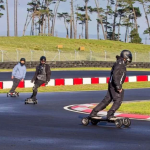
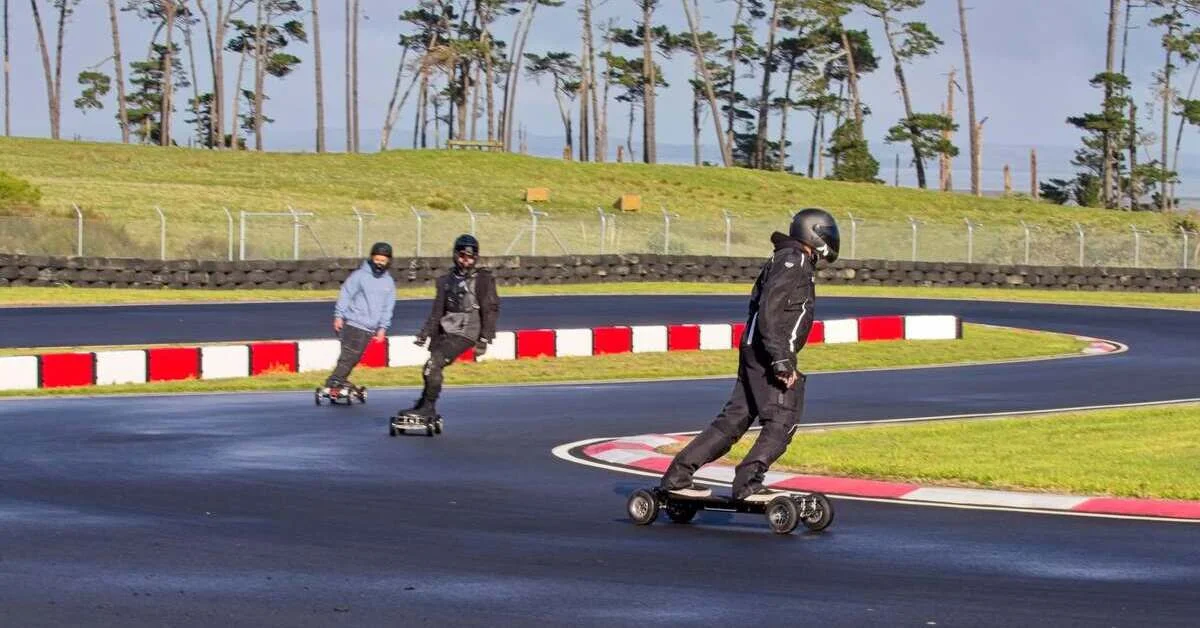
Skateboards first became popular in the 1950s, particularly with Californian surfers who wanted something akin to surfing when conditions were not suitable for surfing. A skateboard consists of a deck connected to wheels via trucks. The trucks are designed so that when a board is tilted to one side by riders shifting their weight the trucks rotate the wheels in that direction, allowing riders to turn the board.
In the 1970s people started adding small petrol engines to propel the skateboard, and in the late 1990s the first electric skateboards appeared, where a handheld controller was used to control the speed. With the advancement in compact electric motor and battery technologies people were able to build their own electric skateboards. Pioneering companies ZBoard and Boosted used crowd funding to provide boards for commercial sale. Unfortunately Boosted ceased production in 2020 but its boards are still remembered fondly by early riders.
Onewheels such as those by Future Motion, Fungineers and Floatwheel are also electric skateboards. But they operate quite differently and so are instead described in Everything to Know about Onewheels.
Electric Skateboard Components
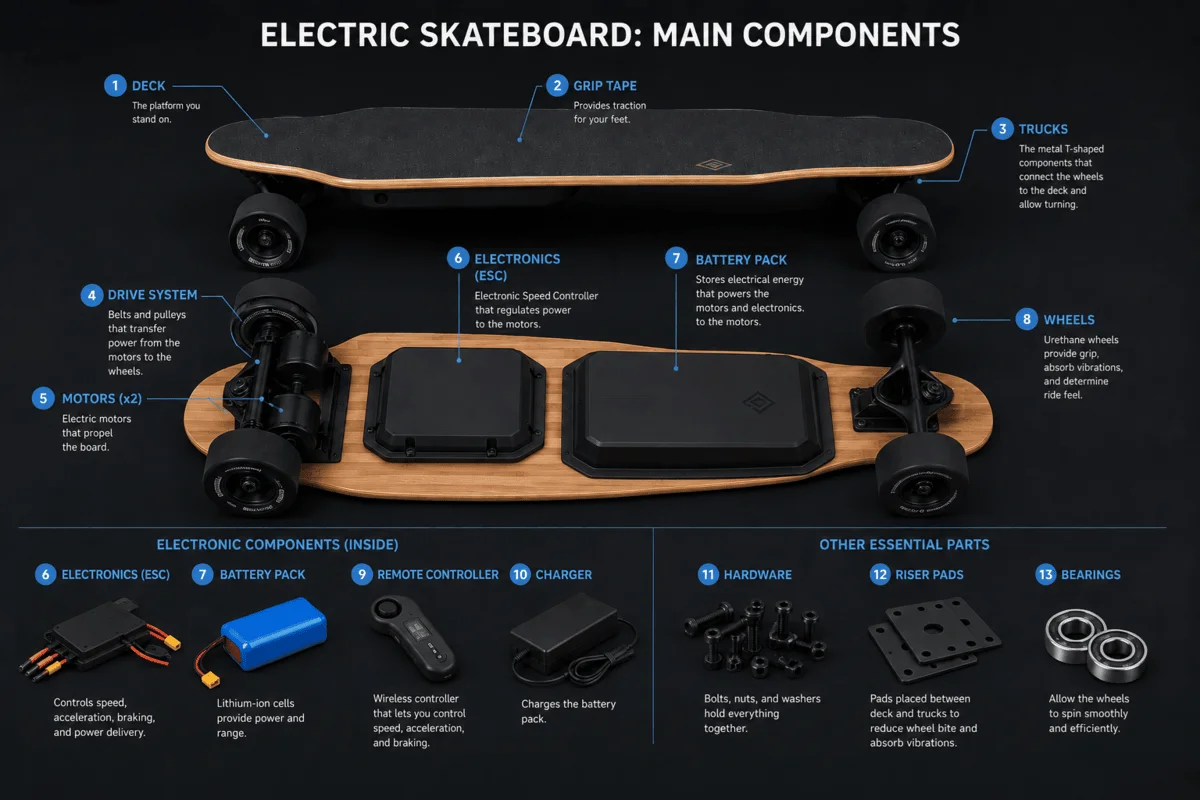
Electric skateboards have some common components:
- Deck. The deck varies in length, width, and curvature depending on the intended board use. Typically it is covered with grip tape to provide foot traction.
- Wheels. The four wheels are commonly either polyurethane (PU) street tyres or else larger rubber all-terrain or off-road pneumatic tyres with inner tubes.
- Trucks. Each of the two trucks attaches to the board by baseplate and holds two wheels on a hanger. The baseplate has a kingpin on which the hanger can rotate, cushioned by bushings. The two trucks are mounted facing in opposite directions so that when the front truck turns one direction the rear truck turns the opposite.
- Motors. Generally two motors are attached to the rear hanger and are connected to the wheels either directly, by belts or by gearboxes. Some boards also have two motors on the front hanger to provide more traction and torque.
- Electronic Speed Controller (ESC). The ESC regulates the current to the MOSFETs at exactly the right times to keep the rotors turning smoothly within the motors and maintain the board speed.
- Remote controller held in a hand. The controller typically uses Bluetooth to communicate with the ESC to accelerate the motors or slow the board using regenerative braking.
Deck
Electric skateboard decks are typically either shortboard (classic or oldschool shape) or longboard depending on their length. Shortboards are generally lighter and more maneuverable whereas longboards have more space for larger batteries and a longer wheelbase giving more stability. The deck cross-section shape also varies between flat (ideal for cruising) and concave (to enhance grip), and along its length might be flatter (providing more ground clearance for off-road) or dropped down (lower centre of gravity helpful with stability at speed).
Decks are often made from layers of bamboo, providing good flex for smoothing vibrations from road bumps and a comfortable carving experience, although flexible decks are more challenging to waterproof and not as stable at speed. Strength and durability can be added to the deck by making composite bamboo and fibreglass or maple layers. Carbon fibre decks are popular in premium boards, they are lighter and much more rigid, providing more stability and robustness but more expensive and they absorb fewer vibrations.
Wheels
Street wheels are solid polyurethane (PU) tyres between 75-105mm diameter. They are designed for riding on smooth pavement, do not deform so respond quickly, give good range and require little maintenance. They do transmit any bumps through to the deck so result in a less comfortable ride on rough pavement, and quickly lose traction on loose or any wet surfaces. To compensate for some of their disadvantages Cloudwheels manufacture street tyres that can be a bit larger and made from a softer material.
Pneumatic tyres are rubber tyres with inflatable inner tubes generally between 150 and 175mm diameter. They are designed for handling rougher terrain, and provide better traction on grass, off-road and in slightly wet conditions (skateboards are not intended for riding in very wet conditions). Depending on their tread design they might be classified as all-terrain (moderate off-road but also suitable for pavement) or off-road (deeper tread pattern designed for better grip on rough surfaces encountered on trails). As they deform as they rotate the range is lower and they are less responsive compared to street tyres, as well as requiring more frequent replacement due to wear and punctures. But they do handle a much wider range of surfaces than do street tyres.
Trucks
The trucks are fundamental to how any skateboard operates. The baseplate is bolted to the underside of the board and has a kingpin which passes through a hole in the hanger and a pivot indentation which allows the hanger to rotate. The pivot holds a replaceable pivot cup to reduce friction as the hanger rotates, and the kingpin has upper and lower replaceable bushings which compress as the hanger rotates and push the hanger back to a neutral position. The tightness of the kingpin nut along with the density and shape (barrel versus cone) of the bushing affect how easily the truck allows turns, striking a configurable balance between stability and turning ease. The angle of the kingpin from the baseplate also affects the turning, more away from vertical gives tighter turns and more sensitivity.
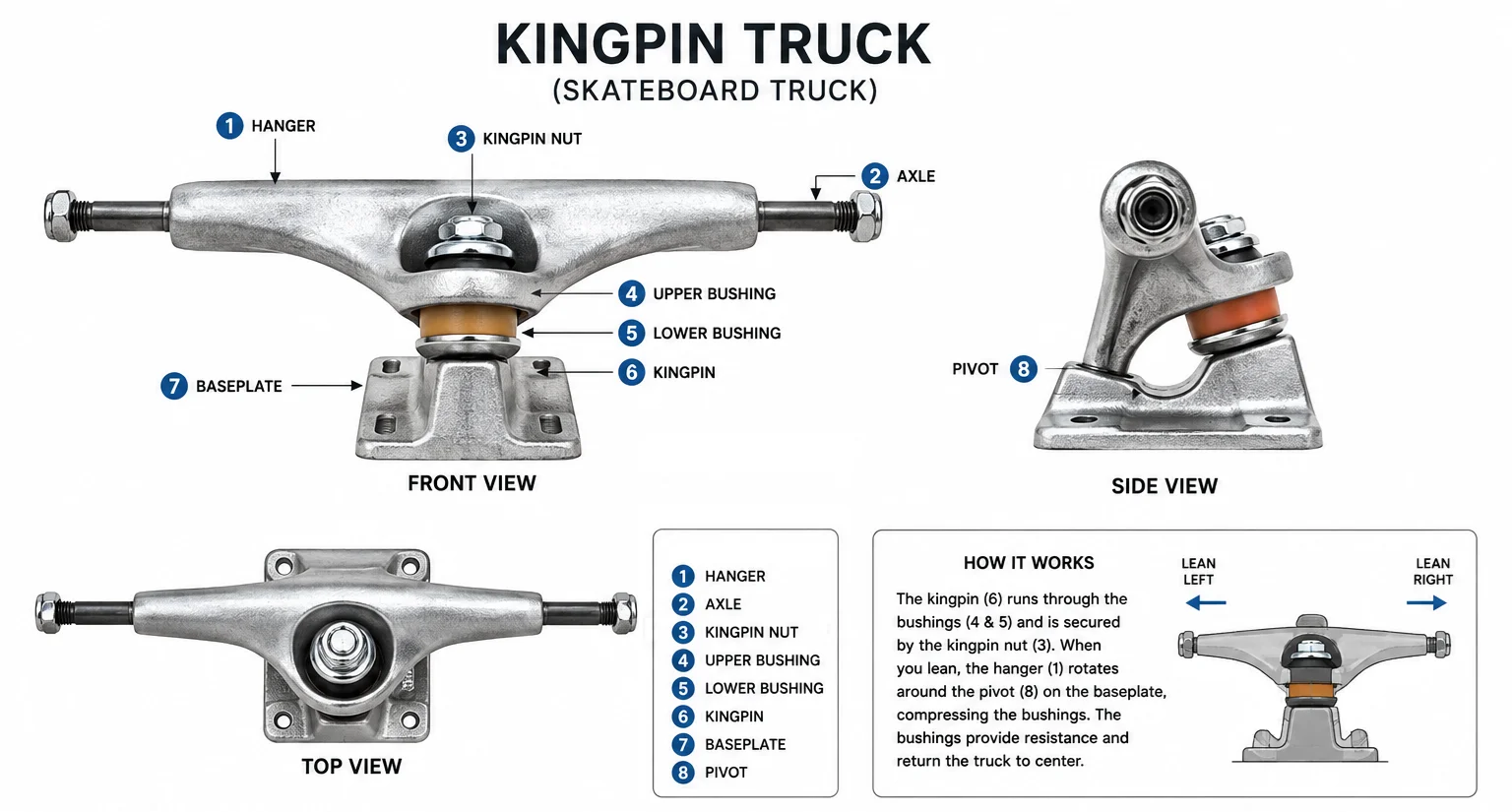
A Traditional Kingpin (TKP) is a simple truck design often used on smaller street boards that positions the pivot on the opposite side of the hanger axle from the kingpin, with the kingpin on the inside of the board and pivot on the outside (illustrated above). It is a low-profile design that is stable at moderate speeds, but has limited turning and often not suitable for carving at high speeds.
A Reverse Kingpin (RKP) flips the location of the kingpin to be on the outside of the board, sitting between the pivot and the hanger axle. It sits higher than the TKP, has much better stability at speed, and more stability in turning so is popular for longboards.
A Double Kingpin (DKP) stacks two TKP one atop the other with both kingpins on the inside of the board. The stacked trucks allows for very tight turning and a great loose carving ride, but is less stable at higher speeds.
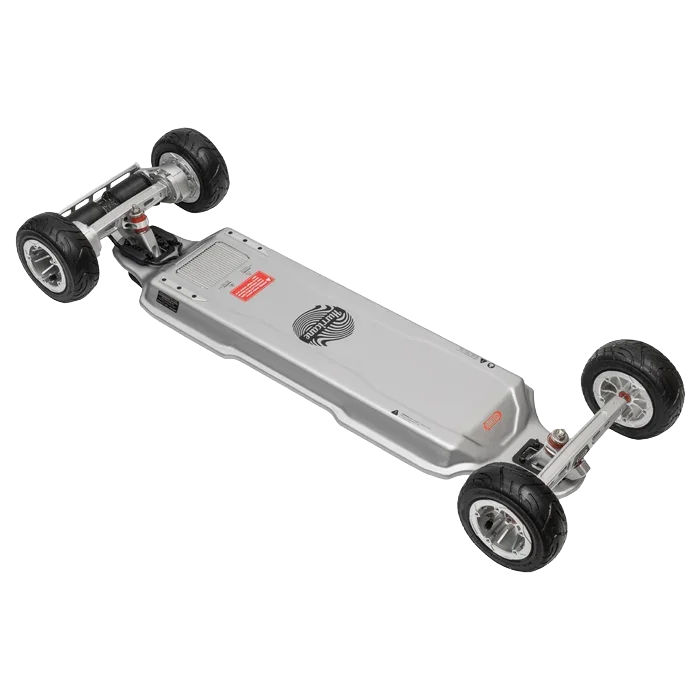
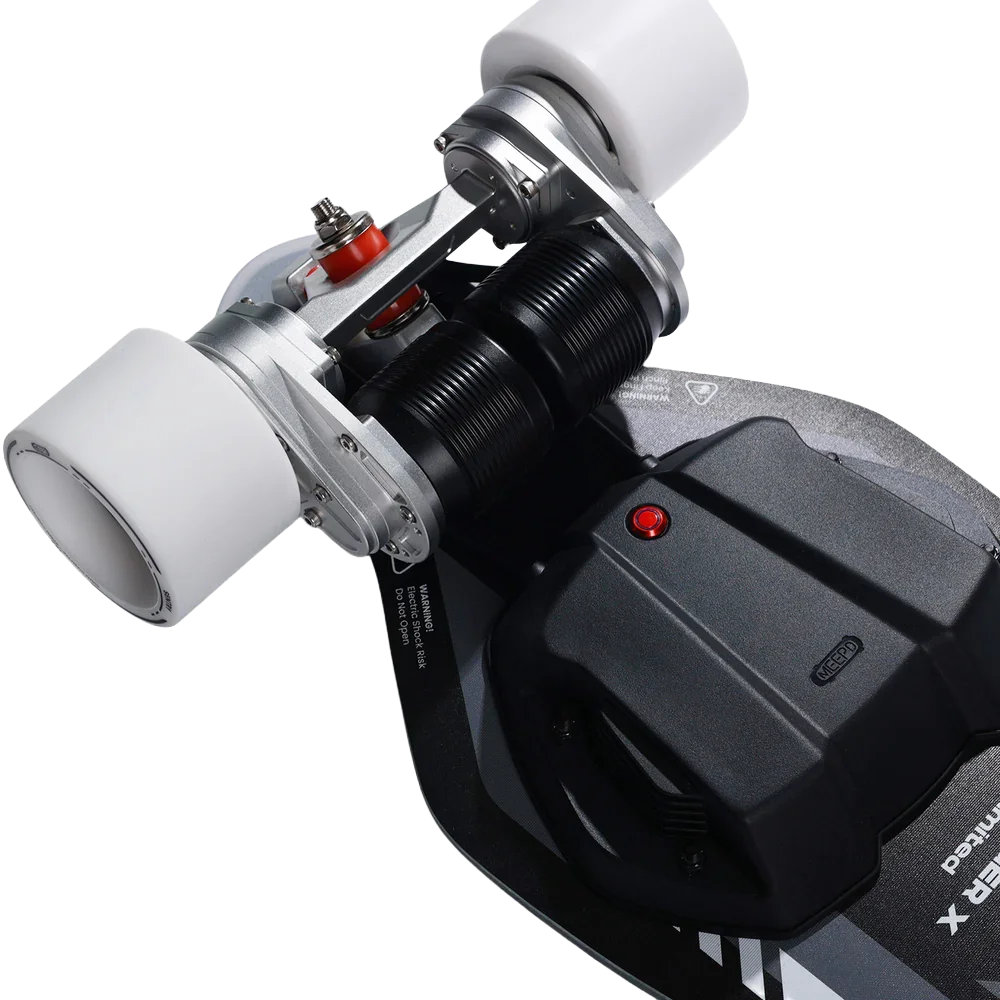
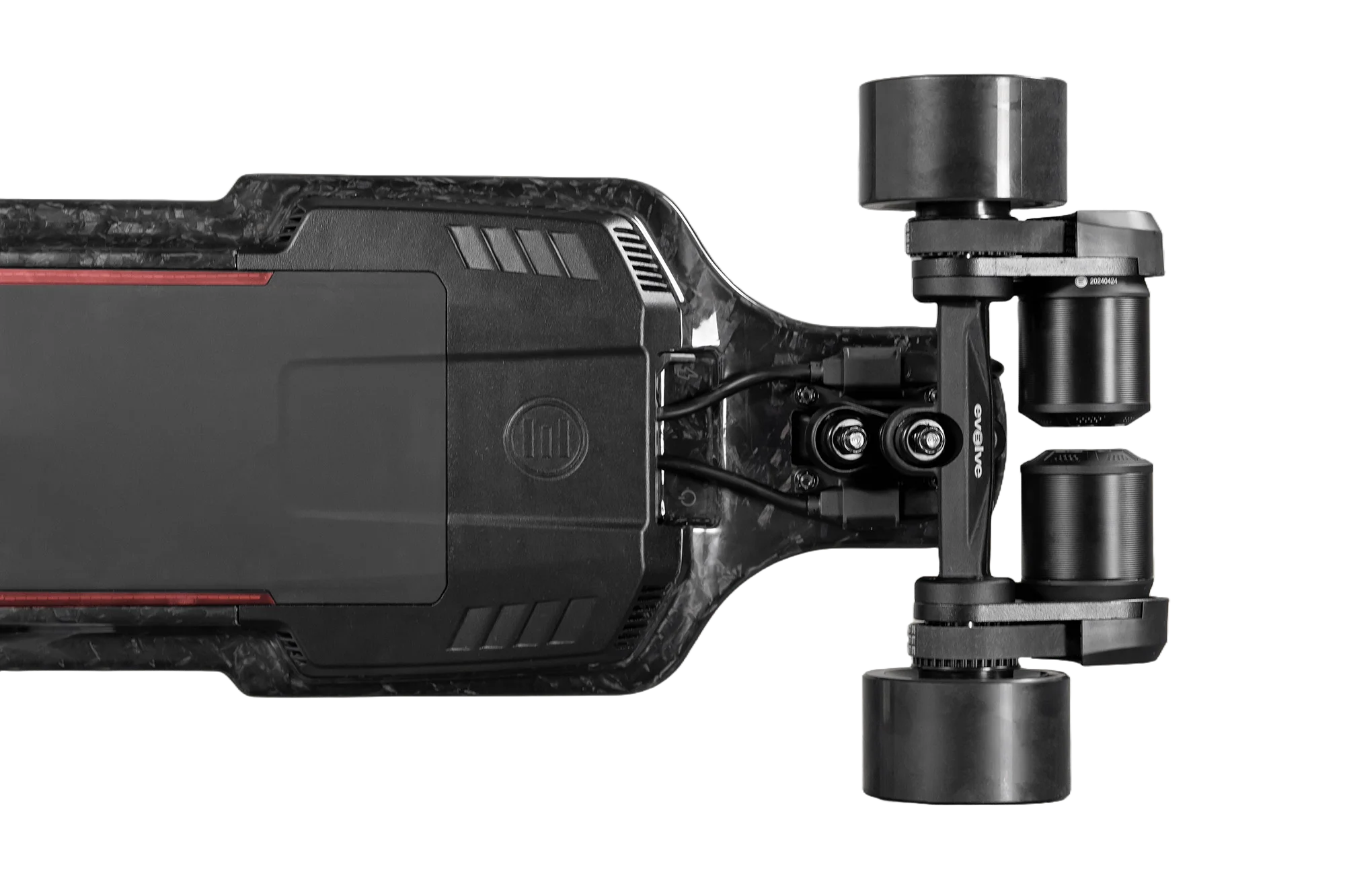
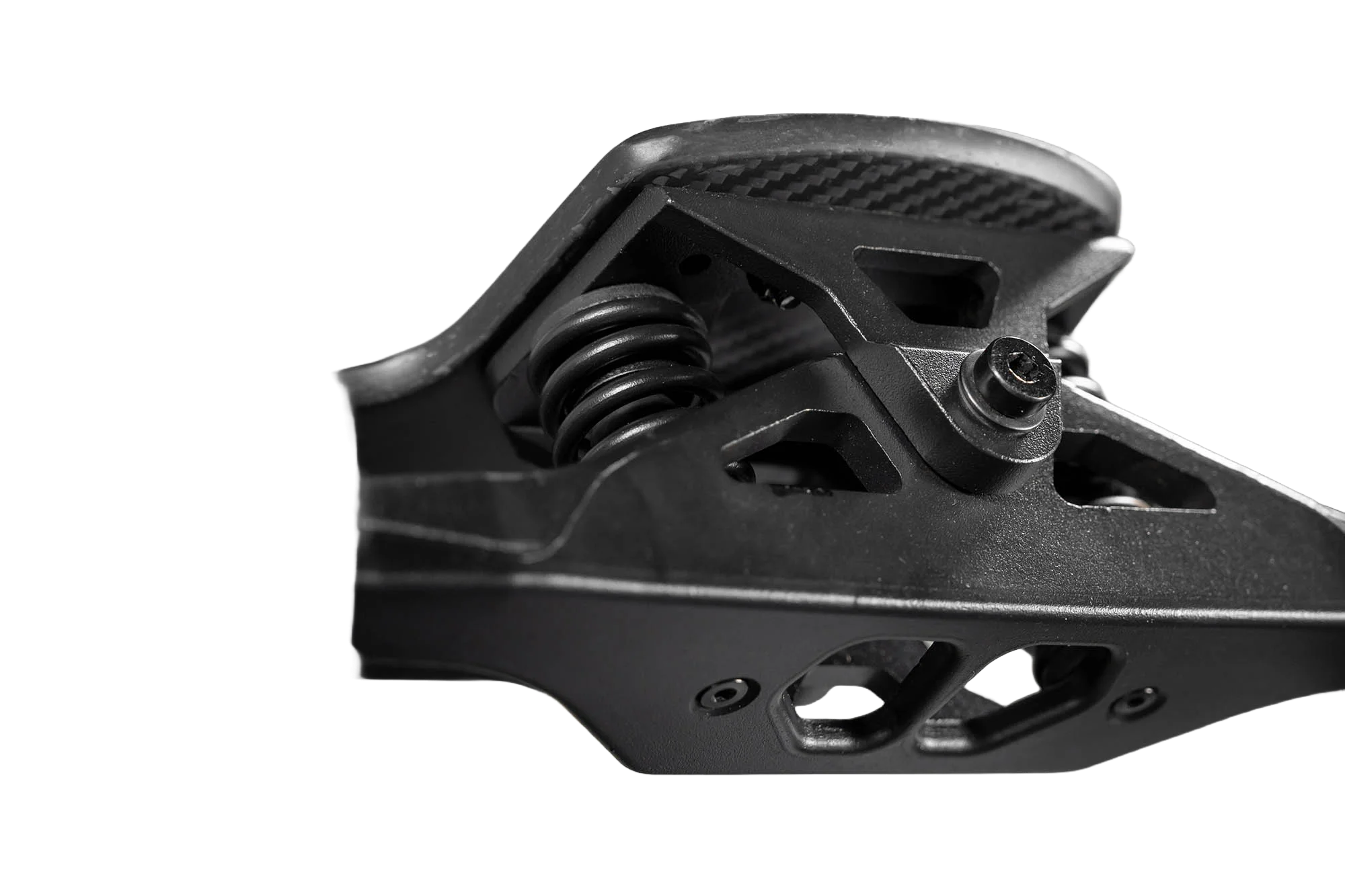
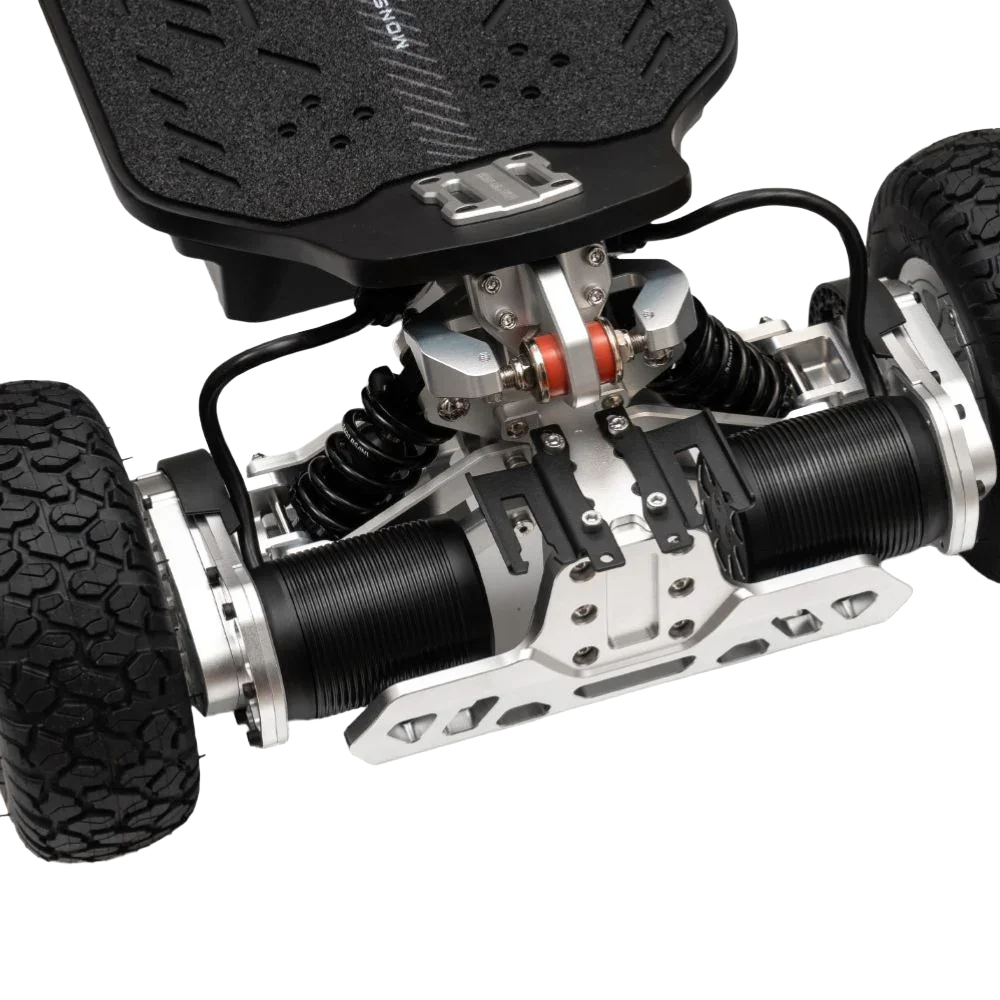
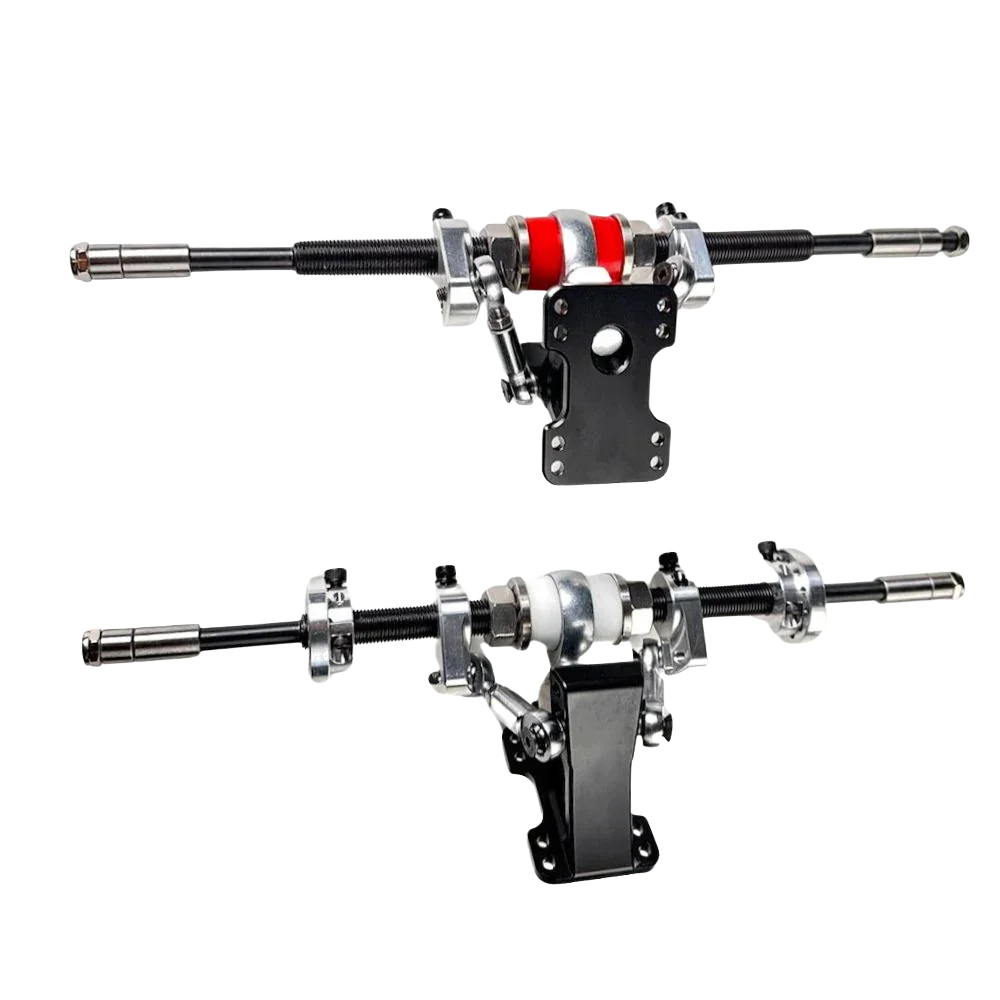
TKP, RKP, or DKP trucks are used in the majority of most electric skateboards. However, for more specialised use cases there are some more advanced truck designs. Channel trucks provide suspension either using two springs or shock bushings mounted either side of the kingpin, and are often used on premium electric mountain boards to provide stability on rough terrain. 3-link trucks were created by Stooge Raceboards and sold by Meepo to the wider electric skateboard racing community. When properly configured 3-link trucks provide excellent stability at high speed but also allow tight turns.
Motors
The two motors that propel an electric skateboard are mounted on the rear hanger so they rotate with the trucks and remain inline with the wheels. For boards that require extra traction and torque the two motors might be swapped for four smaller motors, with two placed with each of the trucks to give a four wheel drive board.
Electric motors for skateboards are generally specified using four numbers, the first pair of numbers give the external diameter of the motor (in mm), and the second pair give the external length of the motor. Generally the larger diameter and longer motors provide more power, although it does also depend on the actual stator size, the motor windings, and the size and shape of the magnets within the motor. For example, the very popular Evolve GTR board and the Evolve Fusion use two 6368 motors each providing 3000 Watt power, whereas the premium Evolve Diablo uses 6374 motors each providing 3500 Watt power. The largest motor found on commercial boards is the DXW-6890, each rated at 7600 Watt on the Meepo Monster 2500, although the motor itself can peak at 9000 Watt.
There are four ways the motors can be connected to the wheels:
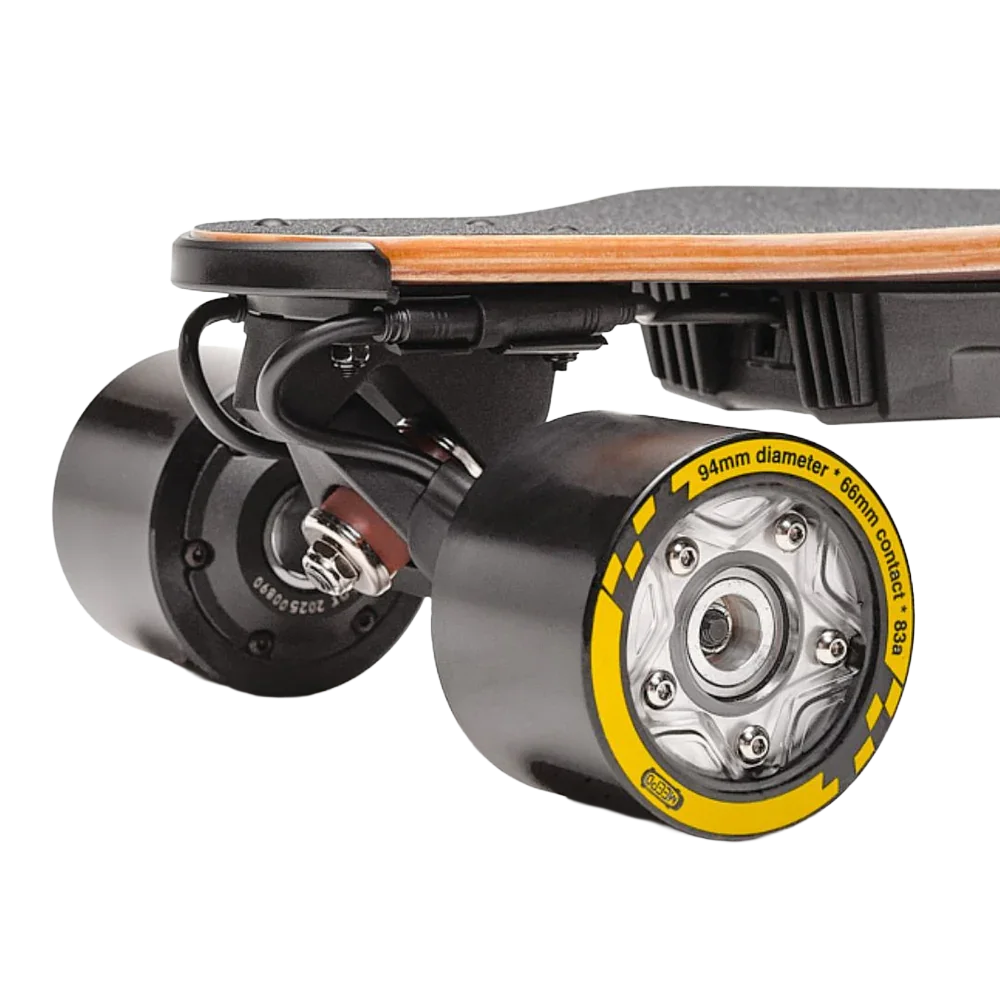
- Hub motor which is positioned within the wheel and surrounded by a polyurethane sleeve which acts as the tyre. Hub motors are discrete, light, quiet, require little maintenance, and can have slightly better water resistance as there are few exposed components. But their diameter is limited with the wheel size so they tend to only be each capable of 500-800 Watt maximum, and have limited sleeve options for their tyres. They are often used for budget street boards where motor power is not a priority.
- Direct drive motors which are positioned inline with the wheel on the axle. This allows for a wider range of tyres to be used compared to a hub motor but the motor is sitting exposed very low to the ground, and is again limited by constraints on its size.
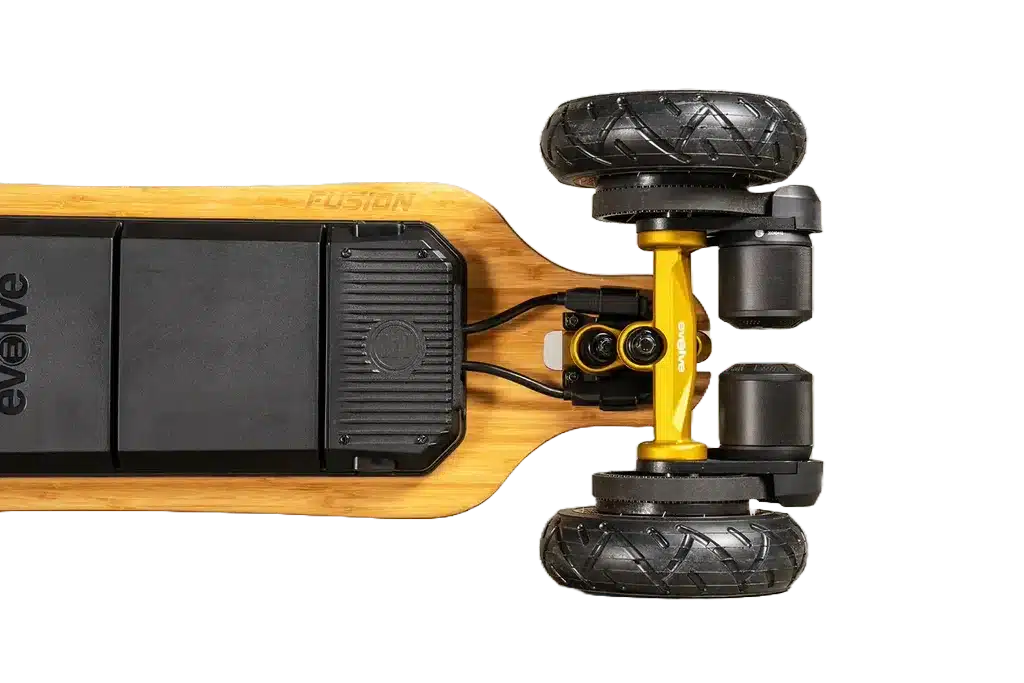
- Outrunner motor with belt drive, where an external motor is connected to the wheel via a toothed belt. This allows a larger motor to be used, the belt/wheel gear/tyre can be changed to allow different speed versus torque configurations. Belts do wear over time, can get debris caught or break so require periodic tension adjustments and replacement. Belt drives are very popular for all-terrain and 2-in-1 boards (which come with both all-terrain and street tyres).
- Outrunner motor with gear drive, where an external motor is connected to the wheel via a gear system. This also allows a larger motor to be used, being a closed system it is less exposed to debris, is very responsive when accelerating/braking and can offer high torque and top speeds. Modern gear drives are also quiet. Typically though they are heaver and more expensive than belt drives, don’t allow adjusting gear ratios and gear drive maintenance (although less frequent than for a belt drive) is a bit more complex. Gear drives are popular on newer premium boards and also chosen by heavier riders.
Types of Electric Skateboards
In general electric skateboards can be classified as follows depending on their use:
- Shortboards, which are typically smaller skateboards with street tyres and popular for shorter commutes and where the board might need to be carried. The most popular examples are the entry-level Meepo Mini 5 with hub motors, and the more powerful “pocket rocket” Evolve Stoke X.
- Street longboards, which are longer skateboards with street tyres and popular for cruising on pavement. The most popular examples are the entry-level Meepo V3 Series Max, the punchy Meepo Voyager X, or the carving-master Evolve GTR Bamboo converted to street wheels.
- All-terrain longboards, for a mixture of off-road and street riding, which are the most common mid-level boards found in NZ. The most popular examples are the entry-level Meepo Rover, the mid-tier Evolve Fusion and Evolve Diablo Carbon, or the premium long-range Meepo Hurricane 1500.
- Off-road or electric mountain boards, which can be used on pavement but come alive off road. Several boutique brands specialise in these boards but two popular models are the Evolve Renegade Diablo and the top-of-the-line Meepo Monster 2500.
Electric Skateboard Brands
Electric skateboard components are readily available for DIY riders that might like to design and build their own board, particularly using the open-source VESC controller.
The largest electric skateboard brands (roughly in descending order of sales) were all set up by passionate skateboarding founders:
- Meepo was founded by Kieran Mao in 2017, and has grown to become one of the world’s leading brands with over 150,000 electric skateboards sold around the world. Meepo produces quality boards with high specifications at competitive prices, and is often considered the best-value electric skateboard brand.
- Evolve Skateboards was born in Australia, by Jeff Anning in 2008, through sheer passion and obsession for finding the link between snowboarding, surfing, and all things carving on land. After scouring the world for the best electric skateboard, Evolve was developed out of the need for aesthetically refined and quality electric skateboards that were focused on creating the ultimate endless wave experience. Evolve is the largest electric skateboard brand in NZ and Australia.
- Backfire Boards introduced the G1 electric skateboard in 2013 and diversified into entry-level and all-terrain hub motor boards, and their high end Lorentz Major mountain board.
- ONSRA is a Swiss company that designs a small range of hub and belt drive short boards and the VELAR belt or gear drive all-terrain board.
- WowGo Board was established in 2017 and mostly sells budget street boards.
There are also many smaller electric skateboard brands, notably the premium brands Lacroix Boards and Trampa, general brands Exway and Acedeck, and budget brands Tynee and Maxfind.
Comparing Popular Boards
| Model | Range | Top Speed | Charge Time | Weight | Motor | Battery | Regular Price |
|---|---|---|---|---|---|---|---|
| Evolve Stoke X | 45 km | 42 km/h | 210 minutes | 10.5 kg | 6000 Watt | 432 Wh | $2299 |
| Evolve GTR Bamboo | 30 km | 38 km/h | 270 minutes | 11.1 kg | 6000 Watt | 504 Wh | $2099 |
| Evolve GTR Carbon | 30 km | 38 km/h | 270 minutes | 10.6 kg | 6000 Watt | 504 Wh | $2199 |
| Evolve Fusion | 40 km | 42 km/h | 240 minutes | 12.5 kg | 6000 Watt | 648 Wh | $2699 |
| Evolve Diablo Bamboo | 50 km | 50 km/h | 240 minutes | 14.1 kg | 7000 Watt | 864 Wh | $3199 |
| Evolve Diablo Carbon | 50 km | 50 km/h | 240 minutes | 13.15 kg | 7000 Watt | 864 Wh | $3499 |
| Evolve Renegade Diablo | 50 km | 50 km/h | 240 minutes | 16.4 kg | 7000 Watt | 864 Wh | $3699 |
| Meepo Mini 5 | 18 km | 45 km/h | 170 minutes | 7.9 kg | 1000 Watt | 144 Wh | $ 899 |
| Meepo V3 Series Max | 32 km | 45 km/h | 180 minutes | 9.0 kg | 1600 Watt | 324 Wh | $ 999 |
| Meepo Rover | 30 km | 45 km/h | 132 minutes | 12 kg | 3600 Watt | 432 Wh | $1399 |
| Meepo Voyager X | 48 km | 54 km/h | 125 minutes | 11 kg | 5600 Watt | 648 Wh | $2199-2399 |
| Meepo Hurricane 1500 | 100 km | 70 km/h | 125 minutes | 20-22 kg | 7600 Watt | 1512 Wh | $3999 |
| Meepo Monster 2500 | 150 km | 80 km/h | 240 minutes | 36 kg | 15200 Watt | 2592 Wh | $6399 |
Protective Gear
At a minimum a helmet and wrist protection is essential at all times. Knee and elbow pads are also recommended, along with leading-shoulder protection if pushing higher speeds. There is always a potential risk of the wheels hitting a bump or slipping in wet conditions. At higher speeds a full-face helmet and abrasion resistant armoured clothing is also recommended.